
There is a herb in Ayurvedic tradition so closely tied to hair health that its Sanskrit name is often translated simply as ‘King of Hair.’ That herb is Bhringraj — and it is the botanical heart of two of Radhvé’s founding formulations, the Keshya Rasayana Tailam and the Keshvara tablets.
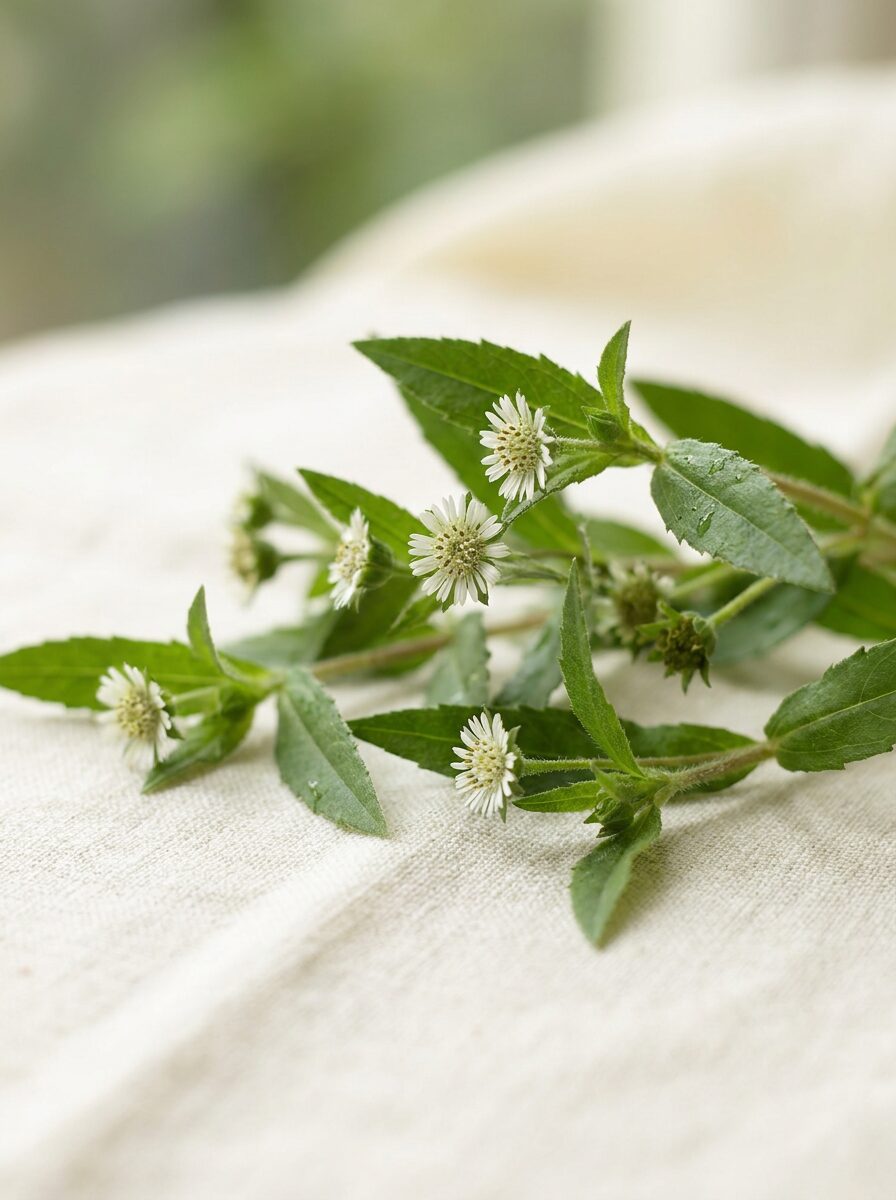
If you have spent any time reading ingredient labels on Ayurvedic hair products, you have almost certainly seen Bhringraj listed somewhere near the top. But most labels stop at the name. Here is the fuller story — what Bhringraj actually is, why Ayurvedic tradition holds it in such high regard, and how it fits into a modern hair care ritual.
What Is Bhringraj?
Bhringraj, botanically known as Eclipta alba, is a small, unassuming plant in the daisy family. It grows low to the ground, with delicate white flowers, and is commonly found across the moist, humid regions of India, often in floodplains and wetlands.
Despite its modest appearance, Bhringraj has held a place of importance in Ayurvedic texts for centuries. It appears in classical Ayurvedic literature as a Keshya herb — one specifically associated with hair — and has long been used in traditional formulations for scalp and hair care.
Why ‘King of Hair’?
The title isn’t marketing language. It reflects how consistently Bhringraj appears across generations of Ayurvedic hair care practice, from household oil-making traditions to formal Ayurvedic formulations. In traditional use, Bhringraj has been valued for a few consistent reasons:
- Traditionally used to support hair strength — Ayurvedic practice has long paired Bhringraj with scalp massage rituals believed to support the conditions for healthy hair.
- Traditionally associated with reducing premature greying — one of the most cited traditional uses of Bhringraj in Ayurvedic households.
- Used alongside other Rasayana herbs — Bhringraj rarely appears alone. It is traditionally combined with herbs like Amla and Brahmi, forming a small ecosystem of botanicals that Ayurveda treats as complementary rather than standalone remedies.
A note on how we talk about this: Radhvé describes Bhringraj’s traditional Ayurvedic uses because that history is real and worth understanding. We do not claim that Bhringraj, or any Radhvé product, treats or cures any medical condition. If you have a specific scalp or hair concern, a dermatologist is always the right first call.
Where Bhringraj Grows
One detail that often gets lost in generic ingredient write-ups: where a herb grows matters. Bhringraj likes damp, biodiverse ground, and it is a hardy, familiar plant in many parts of India.
For Radhvé, Bhringraj is a botanical with a long place in Ayurvedic tradition, and it is one of the founding herbs behind our formulations.
How Bhringraj Is Traditionally Used
In most Ayurvedic households, Bhringraj hasn’t historically been used on its own. It’s typically infused into a carrier oil, warmed slightly, and massaged into the scalp — a practice that Ayurveda treats as much as a moment of care as a treatment. The ritual matters as much as the ingredient.
A traditional Bhringraj oil application generally follows a simple rhythm:
- Warm the oil gently.
- Massage into the scalp in sections, using gentle circular motion.
- Leave the oil on — anywhere from 30 minutes to overnight, depending on the tradition and the person.
- Wash out with a gentle, herb-based cleanser.
- Repeat consistently, usually a few times a week, rather than as a one-off treatment.
That consistency is the part modern hair care often skips past. Ayurveda has never treated Bhringraj, or any single herb, as a quick fix. It’s a habit built over weeks, not a promise fulfilled overnight.
Bhringraj in Radhvé
Bhringraj is one of the founding botanicals in two Radhvé formulations:
- Keshya Rasayana Tailam — our herb-enriched hair therapy oil, where Bhringraj is blended with Amla, Brahmi, and eight other traditional botanicals into a coconut oil base.
- Keshvara Hair Wellness Tablets — a daily Ayurvedic tablet where Bhringraj works alongside Amla, Ghritkumari, Methi, and Mandukparnee to support hair wellness from within, rather than only from the scalp outward.
Using both together — the oil applied weekly, the tablet taken daily — reflects how Ayurveda has traditionally approached hair care: as a system with more than one entry point, not a single product doing all the work.
A Herb Worth Understanding, Not Just Listing
It’s easy for an ingredient like Bhringraj to become a bullet point on a label — another name in a long list that most people scroll past. But behind that name is a plant that has been part of Indian hair care tradition for generations, growing in the same biodiverse terrain that shapes so much of what Radhvé makes.
Understanding an ingredient doesn’t require a botany degree. It just asks a little more attention than a label usually gets.
Keep reading
- How to oil your hair the Ayurvedic way
- Ayurvedic care for hair fall
- Shop the oil with Bhringraj: Keshya Rasayana Tailam
Pingback: Mustard Oil for Hair: How to Use It the Ayurvedic Way | Radhvé
Pingback: Ayurvedic Hair Growth: A Dosha-Based Ritual — Vata, Pitta, Kapha